It’s Always Been Love
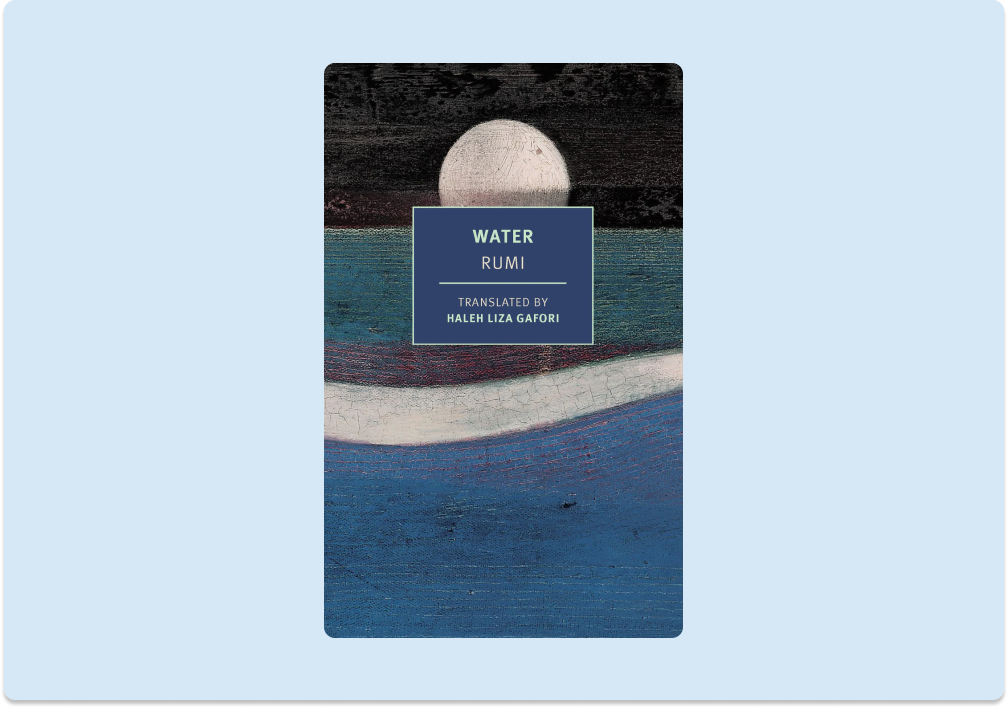
The universal appeal of the 13th-century Persian poet Jalal al-Din Muhammad Rumi’s poetry is undeniable. I began reading Rumi seriously in Coleman Barks’s brilliant, accessible translations in 2018: from Birdsong (“A rose’s rarest essence / lives in the thorn.”) to the immensely stirring selections included in that tome of thematic diversity titled The Essential Rumi (“The power of love came into me, / and I became fierce like a lion, / then tender like the evening star.”) The latter curates the bulk of Rumi’s poems and organizes them according to themes: they range from gambling to Jesus and bewilderment to love. However, it wasn’t until the publication of Haleh Liza Gafori’s Gold, which I read through last year, that I realized that a poet can be better than himself in other languages as his original language is moved around by the originality of others, filtered through their manifest enthusiasm.
Barks, who could neither read nor speak Persian, is an exemplar of that enthusiasm for Rumi’s poetry and so moved it enough for me to know the poet and what he is about. However, coming to Gafori’s translation last year in Gold moved me closer to the heart of Rumi’s work. In Gold, especially through its introduction, one understands what the understanding of the original language spells for the proper accomplishment of good translation. Gafori, though raised in the United States, speaks Persian and is much accustomed to the cultural history of the place and time in which Rumi lived, and that ebbs brilliantly into her work. Hearing the poetry growing up in her house no doubts aids her enthusiasm and the ensuing translating craftsmanship, as she makes clear in the beginning of the introduction to her second selection of his work titled Water:
I first heard the poetry of Molana Rumi when I was a child staring out at the Hudson River from an eighth-floor apartment in New Jersey. My father was reciting a poem about the mastaan—the Lovedrunk—tearing off their chains, or “mind-forg’d manacles” as William Blake would say. The meanings eluded me at the time, but the propulsive, muscular rhythms of the original Persian text left their impression.
The only evidence we need to know Rumi is an immense poet, in both poetic intelligence and scale of production, is that the preoccupation of Gold, like the element, is just as immensely different from that of Water. As the introduction of the former collection has it: “Rumi wrote some sixty-five thousand verses, which are collected in two books: the Masnavi, a didactive and narrative poem in rhyming couplets, uncovering ‘the roots of the roots of the roots of religion,’ as Rumi described it; and the Divan-e Shams-e Tabrizi, a vast gathering of lyric quatrains and ghazals.” Both selections are also curated from his book of lyrics and ghazals, Divan-e Shams-e Tabrizi. If, according to Gafori, “Gold highlights Rumi’s rhapsodic, ecstatic side,” Water, by contrast, is just as rhapsodic but whose primary concern is Love in all its profitable touches and transformative sublimity: “In its pages, Love responds to and is born from the challenges of earthly existence.”
The mundane and the eerily serious make good neighbors of themselves in this selection. In the opening poem, Rumi’s arrested voice is immediate as he gratifies a veiled woman, pleading to gaze upon her face. The whole poem is the plea, and it shows at once a core feature of romantic Arabic poetry, animated by metaphoric elegance and sated by rousing hyperboles, a feature that survives through the works of romantic progenitors like Adonis and Mahmoud Darwish. The first stanza of the poem reads:
You show your face, your flushed face,
and stones spin with joy.
Once again, for the sake of awestruck lovers,
lift the veil from your face, speak out loud,
so learning and logic lose their way,
so men of reason shatter their culture of unreasonable reason,
so water, reflecting you, becomes the jewel,
so fire retires from war.
However, Rumi’s clamors for love in Water is less romantic than spiritual, human, and even ideological. He believes love is the essential human feeling, and it is essential because it is transformative in all the ways that matter. For instance, when Rumi addresses the Golden Horde of the Mongolian Empire, headed by the infamous emperor, Genghis Khan, their bloody sacking and killings across Asia and their neighboring continents during his youth in the early thirteenth century, it happened because Love is not part of the equation coursing through their imperialist mind. His criticism to that is out of both empathic commiseration and mild wonderment because the lack of love in the heart, as the fundament of human relational or social ideology, is the ultimate lack since love, for Rumi, is one of the few things capable of bringing forth in us what Richard Wright once called “a sense of the inexpressibly human.” So, Rumi asks:
Man, man, man,
what kind of lightning are you, setting farms on fire?
What kind of cloud are you, raining down stones?
What kind of hunter?
Caught in your own trap—
a thief stealing from your own house.
You’re sixty years old, you’re seventy years old,
and you’re still uncooked?
Still won’t let Love’s flames near,
won’t let them burn you up?
Enthralled by stuff and status,
the crown, the turban, the king’s beard—
thorns pricking your hands,
but where is your flower?
Gazing in the mirror,
you tilt your hat like a crescent moon—
but where is your light?
Such lack makes an ouroboros of man: self-destructive while destroying others and turning to an element of hate in the hatred of others. For Rumi, Love simplifies the mathematics of being human and at the same time complicates it, albeit the latter often in a playful and drunken sense. But the absence or lack of love in us, Rumi claims, is all complication because of the one-mindedness of oppositional feelings that lead to sadness and destruction. Gafori’s selections in Water strikes sharply at the heart of that lack and sometimes Rumi reads as though trying to persuade us towards the endless possibilities that love affords in poems both long and short.
Since Gafori does away with titling the poems in her two collections of translation unlike Barks in his Essential Rumi, the poems have a certain continuity to them. For example, no sooner had the speaker turned inward “at sunset [to] pray” and shed worldly burdens for the chance to gaze upon the revelation of divine love than he returned to the world, now transformed by that love, seeing it reflected everywhere:
Everywhere, earth is vivid with your colors.
Wonder is struck with wonder.
The heart trembles in awe.
Water is a book to read and reread if not through at once, then at least incrementally just like fine, expensive wine. The ultimate artistic power of the book is in opening it up randomly and wondering marvelously at how current and contemporary the mood and sense of the poem is to us. I just did exactly that, and landed on the left side of the page featuring the following lines:
Beloved, when your sweetness rains down
the price of rock candy plummets.
With figurative economy, Rumi describes precisely the true nature of love, the divine love now wrapped in the relatable shell of romantic lexicon: worldly desires become instantly insignificant at the touch of divine love. In that little poem, Rumi arrives at a simple, but important spiritual truth that love is all we need. Hence, his almost evangelical call, especially in this mono-thematic selection, to make love our watchword, translating it into our actions and engagement amongst ourselves. Obviously timeless and endlessly relatable, Rumi’s Divan-e Shams-e Tabrizi (from whose gargantuan stretch Water is curated) all but concludes that the true salvation for humanity has always been love.