Red upon red upon red
Review of Carey Salerno's The Hungriest Stars
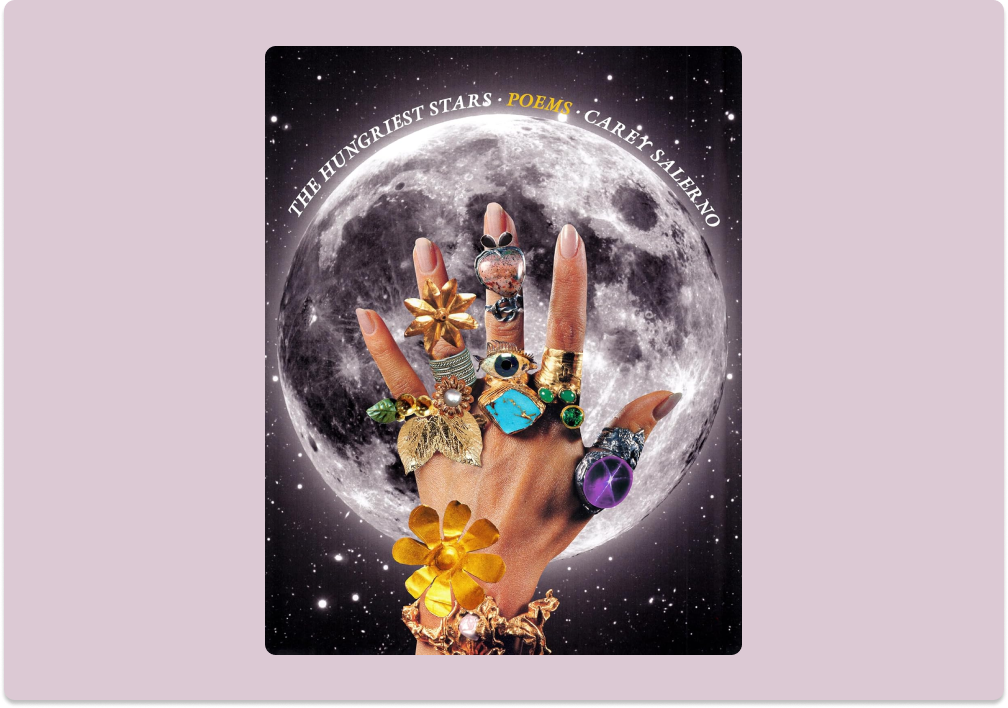
Carey Salerno’s The Hungriest Stars (Persea Books, 2025) is a personal and heartbreaking collection of poems. A restless elegy to the poet’s uterus and a sweeping meditation on human conditions as varied as fertility, desire, bodily autonomy, and survival, the poems that populate the collection move across Salerno’s experiences with endometriosis, adenomyosis, in vitro fertilization (IVF), selective reduction of twins, hysterectomy, and cancer scares. Interweaving clinical medical experiences with lush natural imagery, particularly flowers, gardens, bodies of water, and celestial phenomena, Salerno explores loss (of both potential children and organs), the violence done to and by the body, the complicated relationship between wanting and having, and ultimately, a fierce reclamation of desire. Throughout the book, there are also bracing contradictions: grief sits intensely across and alongside relief, tenderness takes up as much space as rage, and clinical language moves as seriously through the poems as ecstatic metaphors. Finally, a pronounced hunger for life, for pleasure, and for autonomy is the anchorage of the collection; it transforms medical trauma into a meditation on what it means to hunger and to refuse to stop hungering for life and pleasure on one’s own terms.
Salerno is, among other things, a very brave poet because the defining feature of the poems in this collection goes against the grain of our contemporary consumptive sensibility. Wonderfully anachronistic, that feature is the impossibly long lines of the poems, though not the fragmented, genre-blurring lines of conceptual poetics, but syntactically coherent lines that maintain narrative drive in the tradition of Whitman of the catalogues that contemporary poets like Martin Espada have taken up. These poems are also long themselves, with the longest of the bunch going on for six pages, creating a certain physicality upon the page and gesturing her aim towards an absolute expression of her grievous concerns. Even the physicality of her two-line stanzas, as well as the blocks of her zigzaggy ones is as daunting as any long artistic artefact can be in this particular age. And on the ear, too, they are as troubling, if not more, because despite the sweeping shape of the lines, the momentary breathlessness and interminable pauses magnificently brought about by her legions of commas are the true representation of the speaker’s deeply emotionally affected state of mind. The following sprawling lines from “Dandelions (The Adenomyosis)” have some certain haunts of dread and burns of frustration lurking beneath the floor of their fine symmetricality, both intensified by the speaker’s restless free association:
What could embolden these lurking dendrites more than a belly corpulent with estrogenic
waves? In the overgrown, invaded garden, in my body, in the lawn expansive between the
road and the pale, rained-soaked *[sic]* house, I’m seeding tufted lesions of endometriosis,
spoiling them with gobs of caffeine, sugar, and every flit of scotch I serve neat, an
embarrassment of riches. And perhaps we all are as helpless against ourselves, our watch-
face-tapping, shallow graves, against our not so quiet habits, our covert versions of
homeostasis, our slow relent, unable as we are even to halt the toothed spears of the
dandelions, their glossy clustered fury, up early, when, like incited neurons they manifest
ablaze, taproots erect, smearing and sudden on the sleeping yard after so many months gone
dormant.
It is not hard to see that Salerno is as deferential to rhythm-germinating forms as she is to the proper communication of her serious subjects, which is suggested by the specifics of her consistency with the line breaks. Breaking the lines as inorganically, as abruptly, and as soundly as possible, she commandeers the reader’s attention to both what’s been said and what’s coming immediately after. In the lines above, the speaker compares the dandelions, being so terribly invasive as to cause significant economic damage, to her medical condition of adenomyosis—a condition where the tissue that lines the uterus grows into the muscular wall of the uterus, causing the uterus to thicken and enlarge. Having both adenomyosis and endometriosis—another medical condition in which cells similar to the lining of the uterus, or endometrium, grow outside the uterus—at the same time and understandably frustrated, the speaker is reduced to thinking, if ironically, that her liquid intakes, from caffeine to scotch, can be corrective procedures against her medical plights. Even if there’s no irony, the ambiguity of that part of the poem is so sharp because its content, both literal and figurative, is an indication of an overwhelmed psyche.
“[T]he more the poet can show us proportion, balance, and harmony in his form,” writes the brilliant Australian critic, Clive James, writing about the British anthologist Geoffrey Grigson in the pages of The New York Review of Books, “the more effectively he can use it to say that the world has gone awry.” Through her long, visually proportionate two-line stanzas, Salerno shows us effectively the extent of her speaker’s plight. Though it’s hard to reconcile the propulsive energy of the poem with the deplete energy (both physical and emotional) of the speaker’s actual state of being in the poem (which might seem like a bad form), it is nonetheless the refusal to such replication or recreation in the poem that earns some of the poems aesthetic heft. The irony is formally hardwired into the sense of the poems and we can sense it. Take for instance the contents of the lines that follow immediately after the ones quoted above where the speaker, now faced with the unvarnished truth of her condition, speaks interminably of her own complacency, stitching metaphorically yet again the aggressive nature of the dandelions with that of her medical reality:
I forgot how quickly the cycle can change is all. I forgot how at first, I’m all feet
and then it’s just knees when the swells within me spatter the surfaces of what’s being pulled
under, deprived of their oxygen the gasping muscles’ clench deliriously back and forth, rain
funneling into their hollow roots, and the dandelions—to which I learned my anatomy is also
considerably averse, having rubbed the yellow blush-brush blooms on my face with friends
near the reservoir fence at ten, hoping to give the apples of our cheeks color like our idols
and minutes after we pressed the rosettes of sickly leaves on, my cheeks bloomed virulently,
swelling until my eyes sealed shut, the white blood cells and macrophages gluing membranes
together—were flowers I couldn’t see for days when they finally started to appear, when
even then my body was arranging for this rhythm, my parents wetting a washcloth and
pressing it to my face to dissolve my mistake, and like them, there’s so much I want to rake
clear. Even after this long while, even after the skin has become too raw to touch, even after
every year, the dandelions somehow multiply their glut, spreading indignant from the
neighbor’s yard to ours and then from ours to everyone else’s, like at first how the rogue
blood started spilling from the notched uterus, then the ovary, and when its path ruled
unfettered, progressed exultantly onto the colon and liver, kidney and stomach, even the
salmon pink lungs. Now the muscles. Their surfaces peppered, and when the shoots of the
dandelion pierce through the crabgrass, the ryegrass, the dead grass, you know you’re in
trouble but even so this kind of trouble is somehow always the hardest to see coming, its
dazzling acid, its yellow not yet fully blossomed, biting, sour, the sharp ends of the grooved
petals wholly unformed, dour, a gentle containable thing, the deceit of the dandelion
coupling with your hope that the flowers might pass you by this season until one by one they
begin to loudly multiply, to unfurl, and then suddenly every lawn is their wasteland, the body
a wasteland too.
This extended passage, nearly thirty lines of continuous thought, exemplifies Salerno’s method. The devastating progression from a childhood memory of her allergic reaction to dandelions to the body becoming a “wasteland’ is conveyed with an eerie sense of inevitability and visceral detail. This powerful effect is largely achieved through Salerno’s distinctive approach to language and the poem’s internal movement, both of which are delightful.
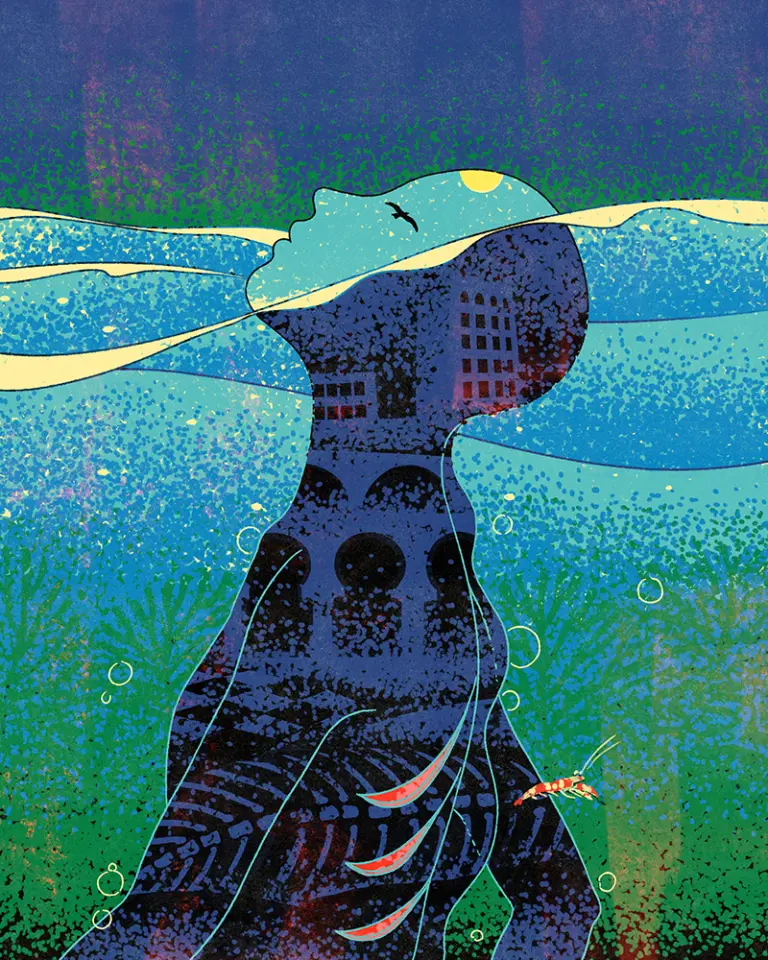
And, as can be inferred in those lines, Salerno’s stylistic signature operates through associative accretion, the adroit technique of piling image upon image, clause upon clause, one long sentence upon another longer sentence, building meaning not through logical progression but through the gravitational pull of accumulated detail. Being a formidable strategy against expressive flatness from Walt Whitman to the late Wallace Stevens of the long poems, this associative accretion or phantasmagoria, if you will, serves the same purpose in The Hungriest Stars. In “The Manatees (The Snowstorm),” the poem accretes associations around grief, using the image of underwater life to explore what remains hidden beneath the surface of daily living. So, it accretes details about what exists “below the surface”—the manatees, their algal beds, seagrass, water hyacinth, “what I can’t see below”—building toward the realization: “What I’m saying is I want to know that something rests beneath our surfaces too. / I want to know that heartaches also happen underwater.” The underwater becomes a space for grief that cannot be directly accessed, let alone witnessed, much like the interior suffering of the hospitalized friend that the poem addresses: “As in on the other end / of the phone line was the news you are back in the hospital, that you hadn’t slept for days, // that you just sat smoking at the window waiting for something, waiting for something.” The accumulation of underwater plant life (“seagrass, its water hyacinth to the fluff of water celery and alligator weed and horsetail paspalum”) creates a sense of hidden abundance that signifies the depth of grief the speaker can only intuit, not see.
Despite the consistent formal or stylistic showmanship of the poems, the same signature style is not always narratively self-aware, at least not as much as it is in “The Manatees,” for instance. This limitation is most pronounced in the poem that opens the book, titled “Sugar Season (Luger),” which establishes the kind of poetry we are about to be confronted with in terms of both style and emotion. The poem is about the violent death of the speaker’s dog named Luger. He was a wildly happy-go-lucky dog until their frustrated neighbour shot him: “It was a hard winter rife with deer meat for dinner, / and damn that dog loved to run deer.” Starting dazzlingly and moving on as impressively in its articulation of that particularly devastating moment in her life, the poem is soon overcome with the story’s grievous heft and nostalgic impression. So overcast with both that it gives us such clearly disruptive interruptions as the following lines, coming immediately after the speaker wants, in her dream—as opposed to in reality which she supposes pointless because of the state of her health, the true nature of which we are yet to be privy to in the poem—to be just like the dog—happy, freewheeling, and unrestrained:
And when I dream, I want to be Luger, that was his name
(His name the name of a gun, and was that fate, we could never say for sure, but the fact
never escaped me, that it was and feels important, that he was tied by name to violence,
and even before he died, to the unloving way in which the needles of the porcupine were
ripped from his nose and days after he bled and licked the blood from his face, wagging
what was left of his lopped off tail, part phantom limb that steadied his body) it’s because
I dream of being more than just my body too, of the way he disappeared into the undulating
wheat.
This interjection is an overweening addition, totally unnecessary to the establishment of the aim of the poem, which is showing the sort of weird correlation that is appearing between Luger’s fate and that of the speaker, now going through this medical tumult without mentioning it in the poem. Everything that comes before and the six stanzas that follow that distracting bracket states that correlation and its importance rather convincingly, but the sentiment of Luger’s death won’t leave Salerno alone, and that creates a visible dent in the sense and smoothness of the poem.
By the virtue of their sprawling physicality on the page, the poems also come through to us as though they are prose and Salerno as a proser of sort, but that’d be an incredibly simplistic, if not totally erroneous, categorisation. The poems, despite their expansive physiques, exudes nothing but the air of the poetic: the narrative and the lyrical have not been better integrated in recent poetry. I mean, the structural linearity of a narrative is always moving synchronously with certain decisive judgements that define the lyric form.
Yet Salerno’s commitment to the poetic extends beyond narrative-lyric integration to her use of sustained metaphor as structural principle. Nowhere is this more evident than in “The Binaries,” a sequence of seven poems scattered throughout the collection that turns astrophysical phenomena into a cosmology of desire. Binary stars—two stars in mutual gravitational orbit, affecting each other’s mass, luminosity, and behavior—become Salerno’s central metaphor for romantic and erotic relationships. But these poems also enact the very contradictions the collection holds at its core: desire that is both sustaining and consuming, relationships that are both tender and violent, hunger that is both creative and destructive. Through the cold precision of astrophysics, Salerno articulates something burning hot, something fundamentally human.
For example, in “The Binaries—Vampire,” the violence of consumption exists alongside the eagerness to be consumed. The poem begins: “From thereforth what else was there to consider, what else but the way in which each idea is suppressed by the force of the possessor star’s consumption at its donor’s very eager throat.” How complicit the donor star is in its own consumption! It “never knew such acts of hunger. Such cataclysmic variables. What near death can drive us to. Nor suspected such strong desire for the authority of them, their self-serving, fanged acts.” Here, Salerno does not subscribe to the easy binary of predator and prey, possessor and victim. Instead, she suggests that desire, the kind of hunger the book’s title invokes, requires both consumption and surrender, both agency and submission. The poem’s final image captures this paradox really well: “Two negatives tendered in choky embrace,” where even negatives (in astrophysics, negatively charged particles; in human terms, destructive forces) create something through their grave coupling. The gravitational reality that bodies in orbit change each other irrevocably is rather fundamental, and striking for us to find out that such change is realised through violence and intimacy, through loss and transformation.
Salerno’s meditation on that productive destruction is extended in “The Binaries—Heartbreaker.” When the smaller star’s gravitational pull creates “massive tidal event[s]” on the larger star’s surface, the result is “the brightest throbs of the larger’s heart,” a luminosity “three times taller already than the sun, over the astrophysical coast.” She locates “the deep comfort of interstellar surrender” in this violent exchange, suggesting that the hunger driving the collection is less interested in preservation as opposed to transformation. To orbit another body is to be changed by it, distorted by it, made to surge and throb in ways that would destroy lesser structures. But binary stars survive these forces. Indeed, they become more luminous because of them. If binary stars can become more luminous through such forces, why not the speaker?
Hunger as a creative force and as the gravitational pull that draws materials into new forms is the book’s ultimate clamour. When Salerno writes in the final Binary poem, “Hungriest,” of the star emerging “skeletal” from her “decadent hibernation” to find “red upon red upon red and dripping down the legs of the overgenerous table” (a Stevensian line in both aesthetics and impression), she asserts the right to appetite after deprivation, to desire after loss, to consumption on one’s own terms. Now awoken to abundance, the star’s teeth ache, her “jaw gone slack,” her interior trembling. But she approaches the feast “Luminous now,” finally permitted to be “the hungriest stars” the title invokes.
Although the connective metaphor of the star in these Binary poems seems abstracted from the speaker’s immediate experience as to refer to her frontally, it is hard nonetheless not to hear in the voice of the speaker a certain wish-fulfilment just like we hear her frustration, comparing the aggressive nature of the dandelions to that of her medical condition in the earlier poems. After all the lesions, surgeries, and scans; all the lost organs, lost children, and lost companion pets; all the binary stars consuming each other in their gravitational embrace, the speaker, being the hungriest star, insists on going on. The book ends incredibly on resilience, the line break and line spacing, creating a sense of considered puzzlement, shows once again Salerno’s technical deference, now in an uncharacteristically short poem:
Darling,
It is
madness how I could go on.
The poems excerpted within the text are from The Hungriest Stars: Poems by Carey Salerno, Persea Books, 2025